
Cavalcade for 1939
A restored version of a home-made disc recording from 1939.
In 1939 Denzil Howson was boarding in Melbourne at the home of an old family friend at 30 Sutherland Road, Armadale, having moved there in 1936 from Castlemaine and completed a three year radio course at the Melbourne Technical College (now RMIT University). On weekends he often explored the Victorian countryside by motor bike and car with his friend Reg Hazelden.
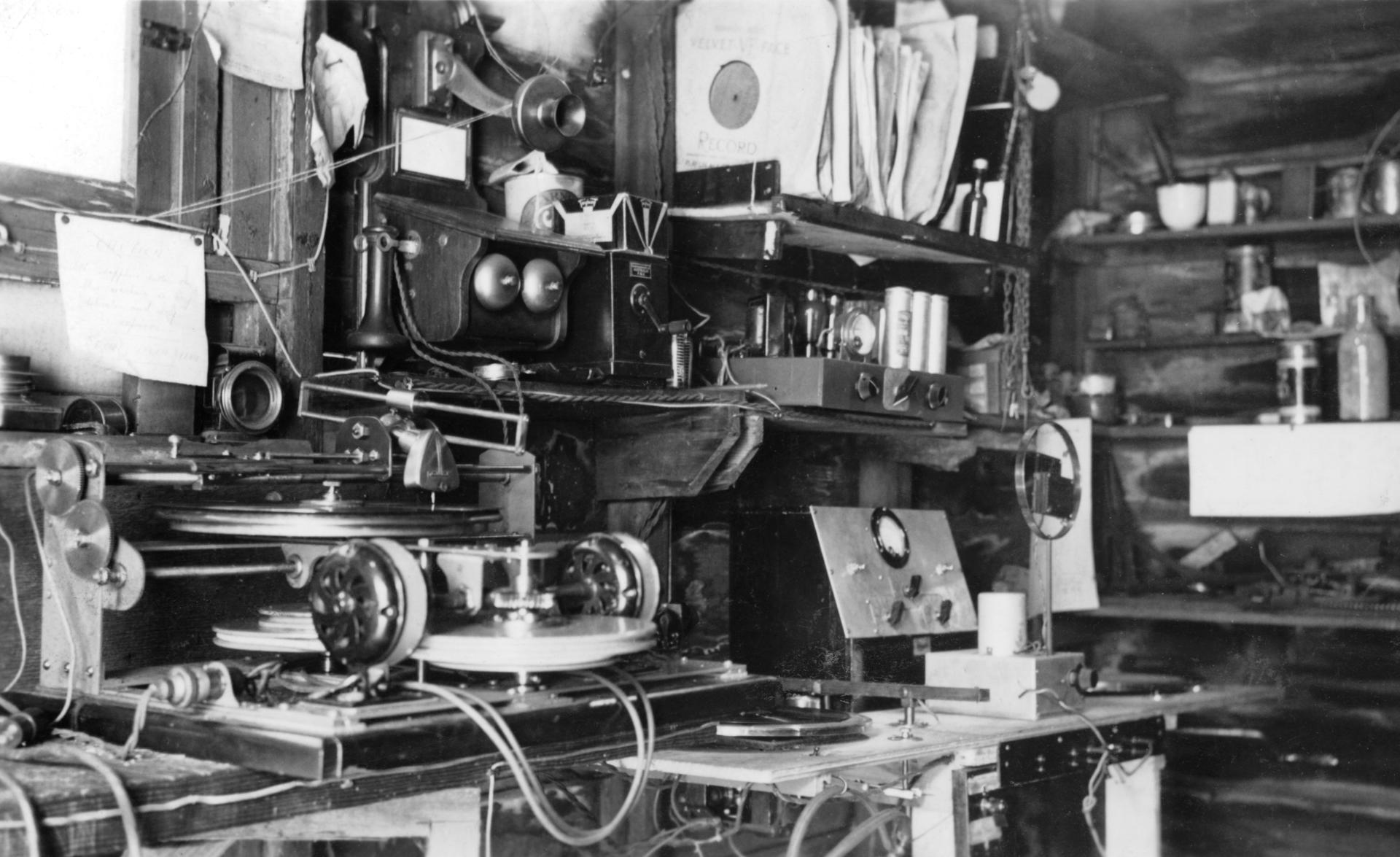
During that time Denzil designed a disc recording machine which was constructed by his father at Castlemaine during the latter part of 1938 and early 1939. It was designed for the recording of standard acetate recording blanks at the two commonly adopted recording speeds of 78 r.p.m. and 33⅓ r.p.m. Hundreds of discs were cut on this machine in the seven years before it was sold.
Denzil had constructed a control room at 30 Sutherland Road, and had installed the disc recorder and its accompanying valve electronics there, shown in the photograph below.
The Recording “Cavalcade for 1939”
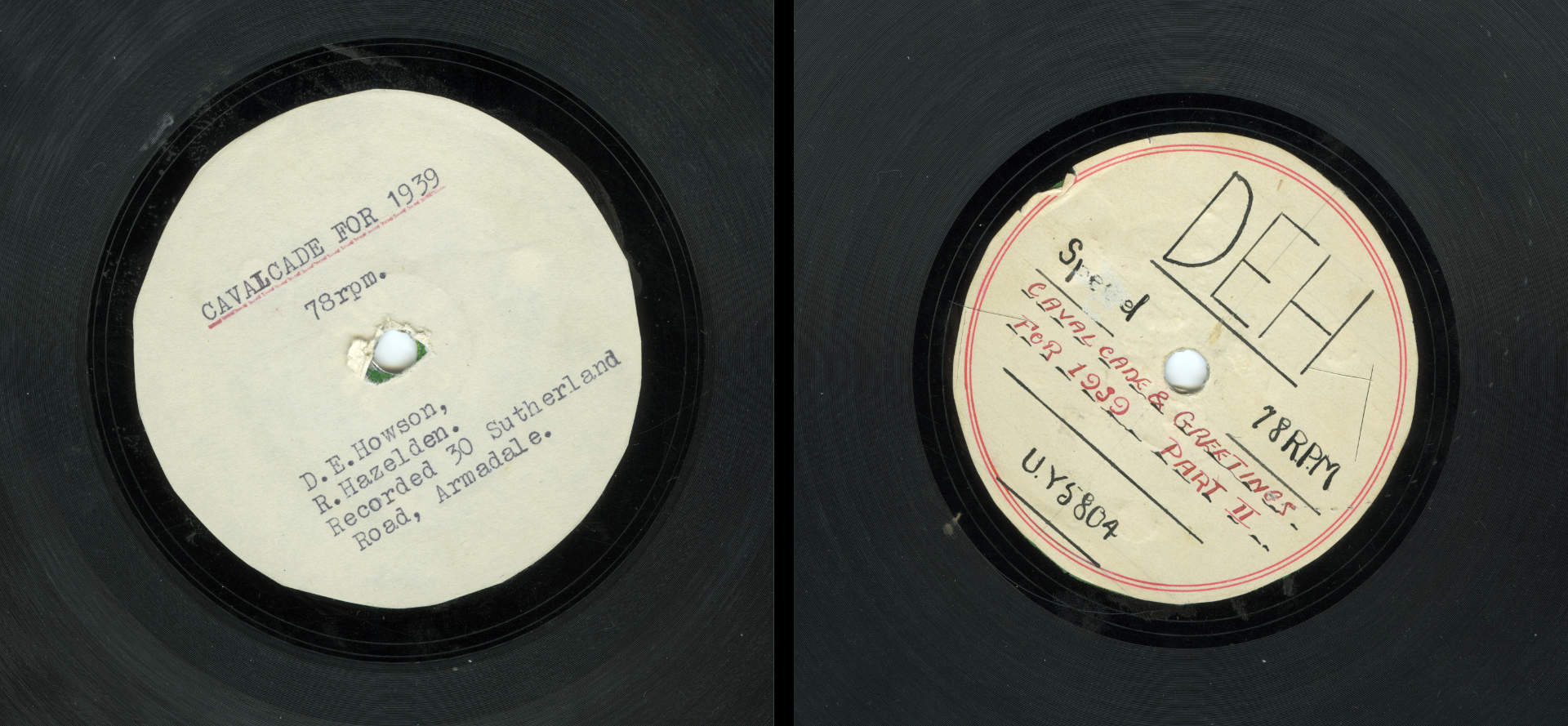
It is with one of those discs, “Cavalcade for 1939”, that we are concerned here. This 78rpm acetate recording survives to this day in a “Home Recording Album” that Denzil put together in 1950. The disc has suffered some degradation common to old acetate recordings.
The contents of are listed here:
Side One
-
Introduction to “Cavalcade for 1939” by Denzil
-
Reg Hazelden introduces the remaining tracks on Side One
-
“Introducing The Family” — Mrs Howson then Mr Howson (originally recorded Easter Sunday 1939)
-
“Time Marches On” (originally recorded Easter Monday 1939)
-
“A Chip Off the Old Block”
Side Two
-
First Successful Vocal Recording (“The Desert Song”)
-
Excerpt from “Memory Trouble” featuring the Rialto Trio (broadcast on 3KZ)
-
Denzil’s Closing Remarks and Dedication to listeners and his parents. Includes recitation of “The Bluebird of Happiness”
In this final part, Denzil mentions looking forward to the new year with a feeling of trepidation. England had declared war on Germany and Australia would inevitably follow suit.
How the Recording Was Made
Denzil describes the recording process for this disc:
“Land-lines were run upstairs to a bedroom, which was used as a studio, and it was from this point that the accompanying recording — ‘Cavalcade for 1939’ was performed.
“An interesting point about this disc is that the opening speech by the author was recorded separately, and then dubbed onto the final disc. This was because either myself or Reg Hazelden (the other voice) had to be ‘on duty’ downstairs in the control room to cut the recording. So, I said my piece while Reg recorded it. Then he stood by to say his piece, while I recorded again from the disc already cut, my opening remarks. Right on cue, Reg came in from the microphone upstairs, and carried on with compering the show, whilst I dubbed in all the recorded excerpts.
“ ‘Cavalcade for 1939’ was recorded in December, 1939 as a form of Christmas greeting for my parents in Castlemaine.”
What Denzil is describing is an early example of what would today be called “bouncing” of tracks — in this case playing back one disc while re-recording the audio onto another disc.
You can listen to Side One and Side Two here:
Listen Now: Click the play button on the audio player:
Download: Click here to download an mp3 (8.1mB).
Listen Now: Click the play button on the audio player:
Download: Click here to download an mp3 (8.7mB).
Restoring These Recordings
The disc recording was transferred on a Garrard 401 turntable with SME 3009 Mk II tone arm and an Audio Technica VM670P cartridge feeding a NAD phono preamplifier and then into a Solid State Logic SSL2 audio interface. The audio was captured using Audio Hijack on a Macintosh Pro laptop.
Acetate discs are subject to deterioration, which results over time in worsening groove noise. Due to the condition of this disc, the noise level on the transfer was very high.
Another problem was that the 1939 technology — the disc recorder, and the replay turntables used for copying from one disc to another — did not have good speed regulation. Hence we have a collection of segments effectively recorded at different speeds. Some were audibly too fast (voices pitched too high) and others too slow (voices pitched too low).
The Variable Pitch module in Izotope RX 11 was used to speed up or slow down each segment so that the voices sounded about right (although there is clearly guesswork involved).
The Izotope De-click and De-crackle filters were also used initially to remove transient noise.
The Izotope “Dialog Isolate” module, which can isolate human speech from non-speech content, helped to extract voices and reduce background noise.
Other Izotope RX filters were also used.
While the resulting audio quality is poor by modern standards, and it has not been possible to remove all the disc surface noise, this restoration has greatly improved it over the initial disc transfer.